When a Deadline Looms

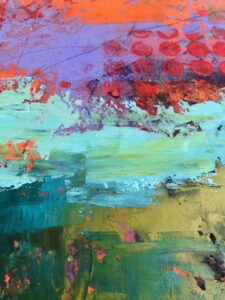
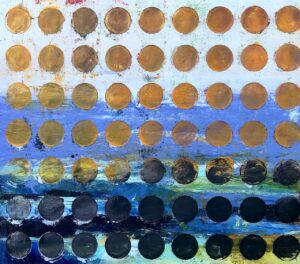
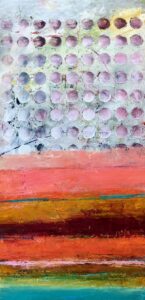
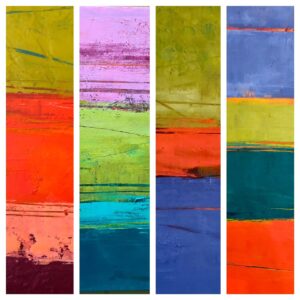
If you read my last post, I shared about my upcoming show at RiverSea Gallery in Astoria and how my initial idea was the theme of waterlines, but somewhere along the way I realized it was no longer a theme I wanted to explore. Instead, I started thinking in bands and swaths of color, a design element I have been smitten with for years. My thoughts went to how I have always been attracted to color field art, so as I painted and worked on my boards, the idea of working in fields of color filled my consciousness. The words Emotional Alignments became the title of my show, and propelled me forward. I knew where I was going and I was excited to get into my studio every day; I had an enthusiasm I hadn’t had in a long time.

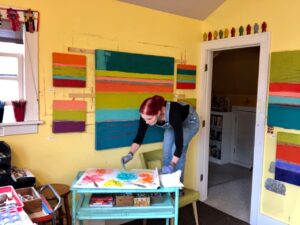
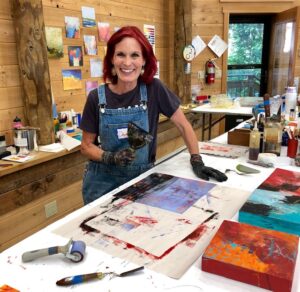
After getting all of my boards prepped, I kicked into full time painting, spending several hours a day in my studio adding layers of oil and cold wax. In my last post, I shared the process of how I prepare my boards with acrylic paint, plaster, and more acrylic paint, and now I’m showing and sharing the process of adding layers of oil paint mixed with cold wax.

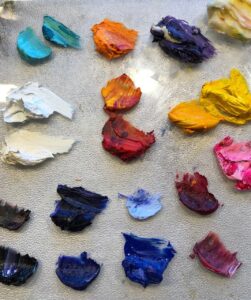
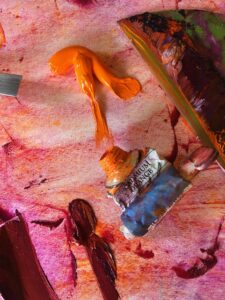
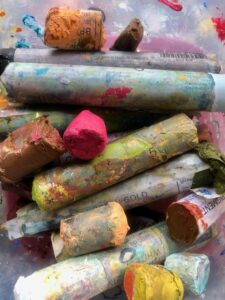
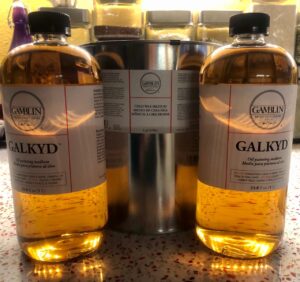
The first order of business is to mix up cold wax with Galkyd (which helps speed the drying time), then mix oil paints with the wax mixture, making it the consistency of whipped butter (or shortening if you are old enough to remember that cooking staple).
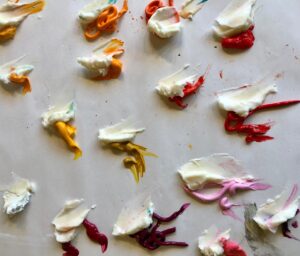
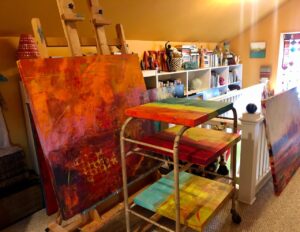
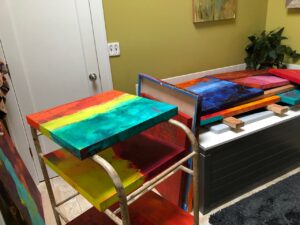
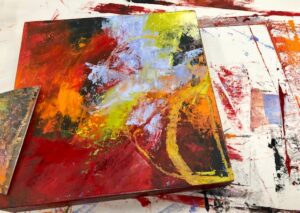
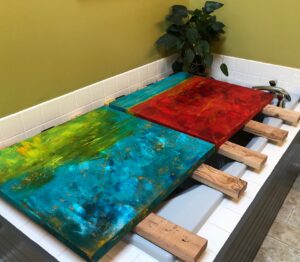
I use the early layers to just get color down so I have something to respond to. I’ve been working on 20 pieces simultaneously, so drying space is at a premium, necessitating spreading out into our bathroom and the upstairs hallway.
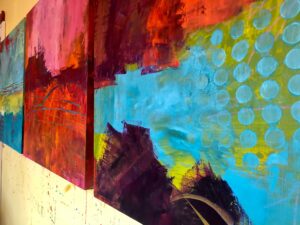
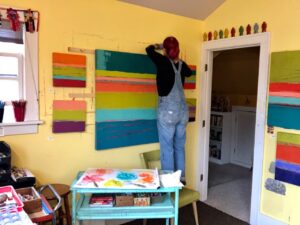
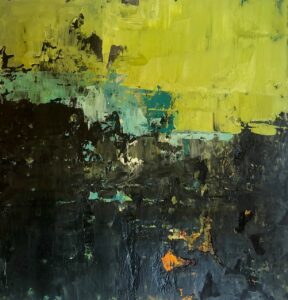
Once I have one or two initial layers of oil and cold wax, often alternating between warm and cool colors so when I’m scratching through the wet paint, the earlier layer is revealed, it is time to begin thinking about a composition. I knew I would be focusing on bands of color, so I just started painting swaths, giving some thought to color, but not too much advance planning at this stage.
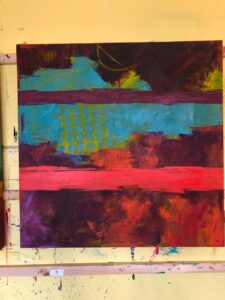
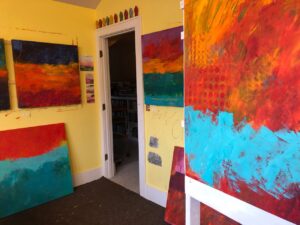
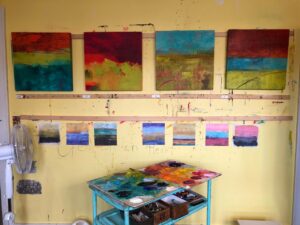
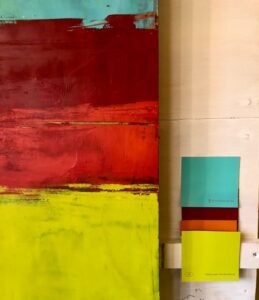
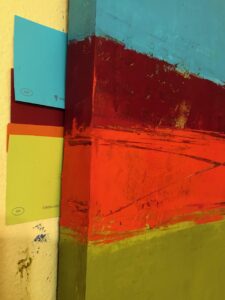
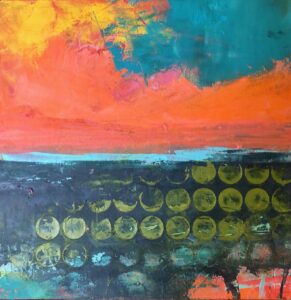
Eventually, I had another layer on the boards and it was time to begin making more informed choices to add variety within the swaths: warm against cool, texture against smooth, bright against dull, light against dark, busy against calm. I had the idea of using paint chips (from the hardware store) to play with color combinations.
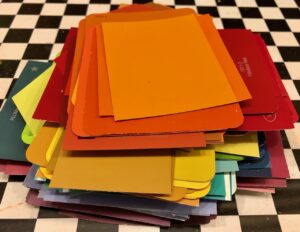
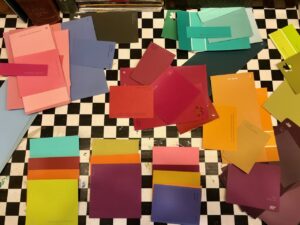
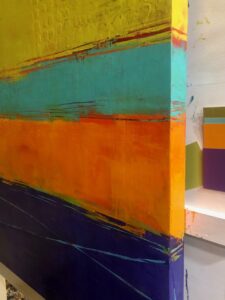
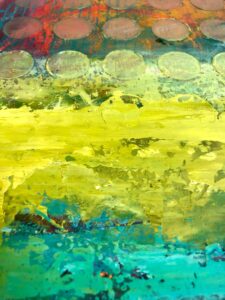
I also gave a great deal of attention to the intersections between the bands of color, the interstices. I have long been fascinated with intersections: drawing into the layers to reveal earlier layers, what colors show through, adding lines of color with the edge of a squeegee, how to create bold interest, how to create quiet interest that invites a viewer to step closer to see the details.
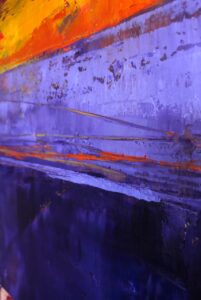
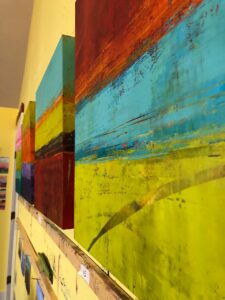
 

And so it goes. Back and forth, adding, subtracting, standing back, scraping, excavating, laying down more paint. Mental and physical gymnastics.
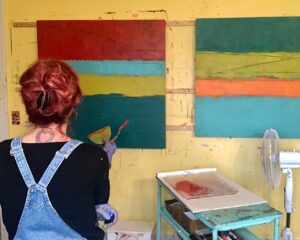
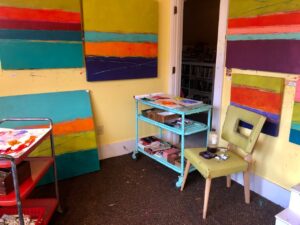
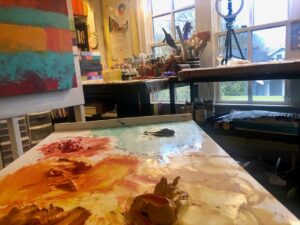
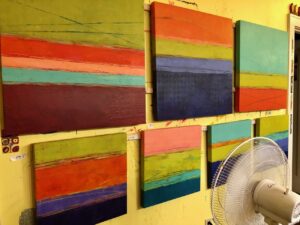
Between painting sessions, is the inbetween, the drying time. I set up a fan and a heater to blow warm, dry air around my studio, a time for the paintings to rest, a time for me to rest. It all seems to help.
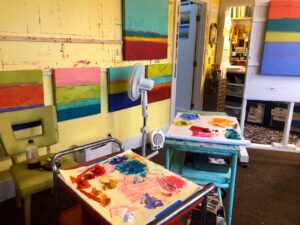
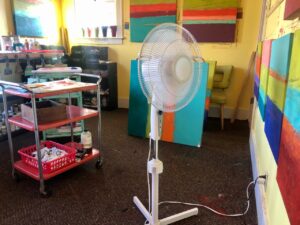
Paintings are being completed and I’m excited about them. They reflect how I have moved through the pandemic, politics, wildfires, and personal traumas this past year. Titling the pieces has been as therapeutic as painting them. I think I might just be okay.
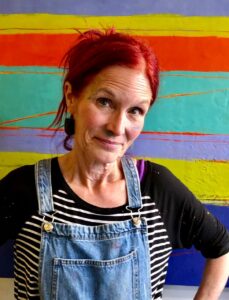
In my next post, I’ll share the completed pieces. The show, Emotional Alignments, opens Saturday, January 9, 2021, at RiverSea Gallery as part of the Astoria monthly Art Walk.
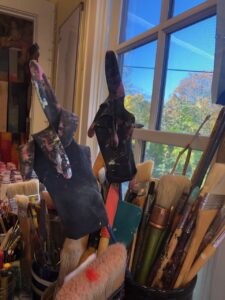
 

The Arduous Task of Preparing for a Show

For the past couple of months I have put my nose to the grindstone. Being in the middle of a pandemic, life outside my house has been meager, so in many ways this has been the ideal time to put myself into a self-imposed studio timeout. I had the opportunity for a show at RiverSea Gallery, a contemporary art gallery in Astoria on the Oregon Coast. I have had art there for several years, I’ve been in group shows, and two years ago I had a show with my friend Stephanie Brockway. I had been thinking about asking for a solo show, but had never approached the gallery owner, Jeannine. Until October. I met with Jeannine and because of the pandemic, she was juggling the rescheduling of shows from 2020 into 2021; then she said that an artist had just cancelled for January 2021 and I could have that slot. In the big gallery. Gulp. Yes, please. Let the madness begin.

I work in layers. Many layers. It goes something like this. Gathering boards and painting them with a layer of acrylic or house paint. Once dry, I slather on a layer of plaster, which needs to dry overnight. The plastered boards are then schlepped outside to be lightly sanded, brought back into the studio, and sealed with a layer of acrylic stain. I like to baptize my boards with words, so I usually scribble a quote or something about how I’m feeling. Then I’m ready to begin actually painting. Because words don’t quite capture the physicality of this process, here is my photo essay depicting the first round of layers.


Now the boards are ready for painting.

When I originally pitched my show to Jeannine, my idea was for a show about waterlines, something I have been passionate about exploring for years. But as I began applying the initial layers of oil and cold wax, I realized the show was no longer about waterlines. When I needed to send an image to Jeannine for her November newsletter, I sent her this message:

I have been consistently working since we met in October, moving forward with the theme of Waterlines. I prepped 15 boards (20×20 inches up to 40×40 inches) with acrylic, plaster, acrylic, and then one to two layers of oil paint mixed with cold wax. As I began the process of reconciling the under layers with a finished composition, it became apparent that my heart wasn’t in a strict interpretation of waterlines. My original vision for the show was bold swaths of color representing waterlines, but as I began applying paint in bright bands of color, I realized what I was experiencing was more than waterlines; it was an emotional response to 2020: the pandemic, politics, and wildfires (as well as a series of personal family hardships). Waterlines always find their way into my pieces as inspiration, but this show isn’t about waterlines, but my emotional response to 2020. So things have changed a bit. I have titled the show: EMOTIONAL ALIGNMENTS. Once I started making this shift last week, my painting took off. I start my days enthusiastic and excited to get into the studio.

In my next post, I’ll share about the evolution of my paintings (now at 20 works in various stages of completion) using oil paint mixed with cold wax medium . . . . and the many hours I spend in my studio.


New Studio? Almost . . . . .

I came very close to signing a lease on a new studio this week. It was bigger, in a great location, and an affordable price. I’m in the middle of preparing for two major shows in 2021, so I was feeling cramped in my current home painting studio and felt like more wall space would help reduce my anxiety.
It was election day that I looked at the space and I was initially excited about the possibilities. Then I came home and really began thinking about it. I would need to cover the floor with canvas and the walls with plastic. Did I really want to paint in a Dexter kill room?  The lighting wasn’t great, but that was solvable. One thing after another and I began to feel more and more unsettled. Or maybe it was just election jitters. And then late into the evening, I knew that this new studio space was not the right fit for me. I conveyed my decision to my most ardent supporter, Howard, and at around 11:30 pm he popped out of bed and walked into my studio, turned the lights on, and just stood there. What can we do to make this space work better for you?  

A couple of ideas emerged from our midnight chatter. My shelf of vintage dolls and doll heads would need to come down so I could appropriate that space for studio storage (what!?!).  I would move my bookshelf so that that wall space could be converted to an area to hang a painting and make my painting supplies more accessible. But probably the best idea of the night: Howard would build me a movable wall so I could hang and work on two additional paintings.

The next day, Howard headed to the hardware store, bought supplies, and spent the rest of the day in the garage building me my movable wall. I’m in love! Not only with that guy in the garage, but with my new wall.

I took down all of my dolls.

I moved my bookshelf (with a little purging) to the closet and moved all of my boards at various stages of completion to the top shelf where the dolls used to live.

My space isn’t perfect, but it is sure a lot more useful. And I still need to use our upstairs landing for storing larger boards and for boards that are drying. Boards are still drying in our bathroom on top of the bathtub, but it is better than moving into a space that wasn’t the right place or the right time.

If you are curious about what my studio looked like last week, go take a look at the fall issue of Subjectiv: A Journal of Visual and Literary Arts, where my previous studio is featured on pages 89-96!

Painting Frenzy


Frenzy might be an overstatement, but I have been spending more time in my studio and after a fairly long hiatus, I have returned to painting with oil and cold wax.

Since 2016, I have taught a four-day Abstracted Landscape class at Sitka for Art and Ecology on the Oregon Coast. Because of the pandemic, this year’s class, which was sold out and scheduled for August 21-24, was canceled (as were all classes at Sitka).

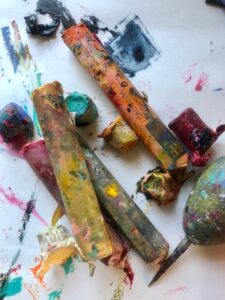
Somehow the idea of not teaching this year inspired me to jump back in to oil and cold wax after several months of painting with acrylics and working on a series of collages. It felt good to crack open the gallon of cold wax and whip up a satisfying mound of wax, begin choosing tubes of oil paint to mix, and dig out my R & F Pigment Sticks.

I had one deadline for a painting (so that was a BIG motivator to get into the studio and do some painting and I’ll share about that project when I can), but otherwise, I decided to pull out old boards that I had used for demos in my Sitka class last year. None of the pieces were completed, they just had fits and starts of paint and marks on them, all used to illustrate techniques and then set aside. It was nice to have something to respond to besides a plain, blank, board.

Technique demo board

I also revamped a few boards that had been completed paintings, but something was niggling at me and those pieces got a light sanding to rough up the surface, and then I started over. It was nice to erase an old painting, but know that there was that sense of history lurking below the surface.

pen·ti·men·to

[ pen-tuh-men-toh ]

noun, plural pen·ti·men·ti  [pen-tuh-men-tee] . Painting.

the presence or emergence of earlier images, forms, or strokes that have been changed and painted over.


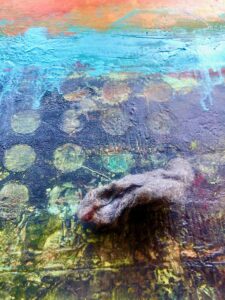
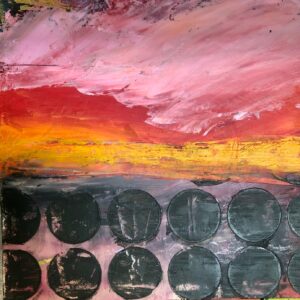
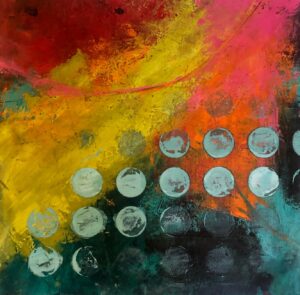
What has emerged during my extended painting sessions is the reoccurring theme of circles. I have always loved polka dots and circles and they have shown up in my work for years, but lately I have tipped over into obsession.

obsession

[/əbˈseSHən/]

noun

the domination of one’s thoughts or feelings by a persistent idea, image, desire, etc.


I’m using circles to excess and eventually I’ll reign myself in. Or not. In the meantime, here are several pieces in various stages of completion. All are on cradled wood substrates and they all have either Venetian plaster or limestone clay (the fancy name for joint compound) as an under layer. Other than that, some of the paint is from an earlier completed piece, or is from a demo at Sitka. Almost all of these have circles somewhere as a layer – in the plaster, buried in the paint, added on top of the paint, or some of the paint removed using a stencil to reveal paint, the circles serving as a window into an earlier layer.


Nature’s Rhythm: Featuring Barbara Bassett & Dayna Collins

Last November, I was invited by Barbara Bassett to do a show with her at her gallery, Barbara Basset Art Gallery, located at Pudding River Wine Cellars. I’ve long admired Barbara’s work and love the setting of her gallery, so I said yes.


We got together several months ago to plan for our show and come up with a title; we both liked Nature’s Rhythm, as it gave us freedom to create in our own styles.

I wrote a quick blurb about my pieces:

Color is an overriding theme in Dayna’s work. Whether she is painting abstract landscapes or creating more nonrepresentational work, color always finds its way into her paintings, mimicking or exaggerating nature’s wild palette. 

We hung our show last week with the help of Sean, the owner and winemaker at Pudding River Wine Cellars.

Barbara worked big, I did a series of 12×12 inch pieces.

We got the show hung quickly, and then we did a timed selfie.

Some of the pieces I will have in the show:

“The Thread of a Path,” plaster, oil, and cold wax, 12×12 inches.
“Spellbound By Thoughts,” plaster, oil, and cold wax, 12×12 inches.
“Grateful For the Silence of the River,” plaster, oil, and cold wax, 12×12 inches.
“A River of Gratitude,” plaster, oil, and cold wax, 12×12 inches.
“A Silver Curtain of Rain,” plaster, oil, and cold wax, 12×12 inches.
“The Hum of Mosquitoes,” plaster, oil, and cold wax, 12×12 inches.
“A Pulsing Wave of Gratitude,” plaster, oil, and cold wax, 12×12 inches.
“The Light Glimmers On,” plaster, oil, and cold wax, 12×12 inches.

The opening reception is Wednesday, May 22, 4:00 – 6:00 pm. The Pudding River Wine Cellars and Barbara Bassett Art Gallery are just a ten-minute drive from from Silverton and 15-minutes from Salem, through the beautiful countryside. The show will be up for several months, so if you can’t make the opening, take a short drive and visit this beautiful winery and gallery.

Scrounged Beauty: The Opening


Stephanie Brockway and Dayna Collins

Here we are the day of our show opening, stopping by for a final sneak peek since we hadn’t yet seen our scrounged letters hanging above the word beauty. We loved it. We spent the day tromping all over Astoria, took a short rest, then returned at 5:00 to celebrate our opening for the rest of the evening.

Final formal photos of Stephanie and me.

Once the guests began to arrive, it was a riot of activity, laughter, fun, chatter, music, visiting, drinking, eating, and general merriment as people came and went, lingered, wandered, stopped back for another look and chat. Stephanie and I were blown away by how many of our friends drove from out of town: Seattle, Salem, Portland, and Albany.

After the last guest drifted away, a group of friends joined us for dinner across the street at Fulio’s and we lingered late into the evening, basking in the afterglow of a successful show and opening party.


Scrounged Beauty

Years of Collecting

After years of being junking partners, my friend Stephanie Brockway and I are doing a show together at RiverSea Gallery in Astoria. Both of us have shown our work at RiverSea for years, and Stephanie had a solo show there a couple of years ago. I show paintings, she shows a combination of paintings and outsider folk art. Scrounged Beauty is found object art, highlighting the best of our collections of found objects, and as some would say, junk.

Months of Auditioning

I spent months pulling things out of drawers, bins, bowls, and trays, choosing which pieces to try out on various pieces of reclaimed wood and prepared boards.

Weeks of Connecting, Titling, Signing, and Photographing

A Day of Hanging

Okay, Colin actually did the hanging, while Steph and I gallivanted around Astoria.

A Sampling of My Pieces (out of 42 I have in the show!)

“Delightful Daydreams,” by Dayna J. Collins
“Giddyup, Little One Trick Pony,” by Dayna J. Collins
“Obscured Thoughts,” by Dayna J. Collins
“A Whisper of Conspiracy,” by Dayna J. Collins
“Drawn Into Memory,” by Dayna J. Collins
“Daily Interactions,” by Dayna J. Collins
“The Tiniest Things Mean Something,” by Dayna J. Collins
“Most Expedient Route,” by Dayna J. Collins
“Painstaking Exactitude,” by Dayna J. Collins
“Traveling Side Show,” by Dayna J. Collins
“Seeing Through Shadows,” by Dayna J. Collins
“Little Time to Talk,” by Dayna J. Collins
“Untroubled By Disturbing Dreams,” by Dayna J. Collins
“Beckoning,” by Dayna J. Collins
“Staring Into the Distance,” by Dayna J. Collins

THE SHOW

Radius 25: Through My Eyes

The Salem Art Association invited established and emerging artists (who live or work within 25 miles of Salem) to submit artwork for Radius 25: Through My Eyes, a juried group exhibition at the Bush Barn Art Center in Salem.

There were 230 entries for this group exhibition, with 50 works of art selected by juror Jennifer H. Pepin, an artist and owner of J. Pepin Art Gallery in Portland, Oregon. My entry, In the Fading Light of Evening, is plaster, oil, and cold wax, 18x24x2 inches, and was one of the 50 pieces selected for the show.

“In the Fading Light of Evening,” by Dayna J. Collins.

The show runs through August 25 at the Salem Art Association’s Bush Art Barn.

Restorative Painting: Sitka Workshop

I wrote a blog post on May 8 about how I was asked by Pat Wheeler if I would take over teaching her Restorative Painting: The Architecture of Memory class at both the Oregon College of Art and Craft and Sitka Center for Art and Ecology, as she was unable to make her annual trip to Oregon. The OCAC class wasn’t a go, but the Sitka class was and it took place last week. What a week.

I arrived late on Monday, and got settled into McKee House, my cabin in the woods.

I spent Monday evening preparing the classroom, one of my favorite things to do. After getting it ready, I turned off the overhead lights and turned on the party lights. A magical space.

Tuesday morning, my students arrived ready to work. I was loosely following Pat’s syllabus, including the addition of her idea for the class to create small works of art on heavy watercolor paper. These pieces could be used as a warm up, as inspiration for bigger pieces, or just for the pleasure of creating small pieces of art. I decided I would start off with a timed warm up, where I quickly told students what to do on three squares of paper spread out across their table: Draw a line, add a swath of paint, make a mark using a color, using a sharp object, draw into the wet paint, make a mark with your eyes closed, ending with the instruction to do whatever they wanted for five minutes. It was a great ice breaker and got everyone ready to jump in with their big boards.

Samples from Pat’s “Art Box,” which she sent to me in advance of our class.


Pat mentioned that she had a couple of boxes in storage at Sitka, which the Studio Tech had pulled out. It was pretty exciting to see what she had left in anticipation of this year’s class. If only Pat had jumped out and surprised us!

Getting down to business, the first step was painting our boards, which was a great way to get our bodies moving. I bought Pat’s signature paint: Benjamin Moore’s Tomato Red and Carbon Copy, along with a periwinkle blue of my choosing. After all of the boards were painted, outside they went to dry.

It was then time to break open our buckets of mud, technically known as joint compound, but the fancy term for using on show cards, limestone clay.

And then the boards went back outside to dry. Fortunately, the weather cooperated for three of our four days.

On Wednesday morning, we began doing one of the messier steps: sanding.

A signature of Pat’s process is incorporating photo transfers onto plastered and sanded boards. I’ve never been very proficient with this technique and although I practiced at my home studio prior to class, I was less than successful. Todd and Kell to the rescue. Both have worked with transfers with great success and I asked if they would be willing to demonstrate this technique.

After their successful transfer demos, everyone jumped in.

Wednesday afternoon, and it was time to begin sharing painting techniques. How to do washes and stains with paint, add and subtract, push and pull, a little of this, a lot of that, writing, stenciling, scritching and scratching . . . .

Sometimes more plaster was needed either as an eraser, or to add interest.


On Friday morning, my final demo was adding a layer of cold wax to seal the layers. Here’s Kira adding cold wax to her beautiful painting.

I worked on a demo piece during the week, and on Friday morning I sealed it with cold wax as well. Here are a few of my favorite areas:

During the week, the studio was a hive of activity. I opened the doors an hour early every day, and kept the studio open into the evening so anyone who wanted extra studio time, could take advantage (and almost everyone did).

On our final afternoon, we created time for show and tell, sharing what we enjoyed about the process, as well as what was challenging.

I drove home grateful for a class willing to accept a substitute teacher, who gave their all and worked hard, and left with a beautiful series of art. Because their work was so beautiful, here are photos of the pieces they chose to share with the class.


Restorative Painting: The Architecture of Memory

I met Pat Wheeler at the Oregon College of Art and Craft (OCAC) in 2009. I had signed up for her The Architecture of Memory: Paintings and Constructions class, using plaster, acrylics, and cold wax. I was hooked. I proceeded to take Pat’s class for several years to hone my skills, but also to be in Pat’s presence and experience her energy, passion, and welcoming spirit. Pat and I became friends and I view Pat as an important mentor in my art journey.


A week ago, I received an email from Pat, asking if I could step in for her and teach both of her Pacific Northwest classes: one at OCAC and the other at Sitka. I was humbled, honored, and a bit overwhelmed. Plans were set in motion. Pat wrote a letter to her enrolled students and class descriptions were revised. Pat and I were in steady contact, collaborating on how I could best represent her in the classes, while bringing my own interpretation and teaching style to the classes.

I was out of town during all of this, taking a class on Whidbey Island. Throughout the week, I was furiously writing myself lists, making notes, reading Pat’s messages and her sources of inspiration. My version of the class began to take shape, starting with Pat’s process, folding in the way I have used Pat’s original process, yet made it my own. I’ve taught my own version of the plaster class myself, but somehow, stepping in for Pat, has a certain reverence to it.

If you aren’t familiar with the process, it is a wonderful experience. Here’s a snippet from the class description:

Dayna works in layers, revealing color, texture, and what came before. Using paint, plaster, charcoal, graphite, scraping, sanding, staining, writing, concealing, and revealing, Dayna will take everyone on a journey of discovery, building up a surface, then tearing a portion away, never fully revealing what came before. Look closely and you’ll see word fragments and decomposing texture. Dayna intentionally utilizes the concept of pentimento, where traces and shadows of earlier layers of paintings are revealed.

A few shots from various stages of the process.


Registration is now open at both OCAC (class runs May 30-June 3) and Sitka (class runs from June 5-June 8). If you have any questions about the classes or the process, please email me: dayna@alleyartstudio.com

I will miss seeing Pat this year, but I’m looking forward to her return to the Pacific Northwest next year.