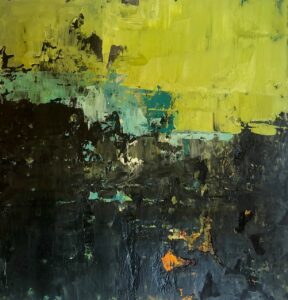
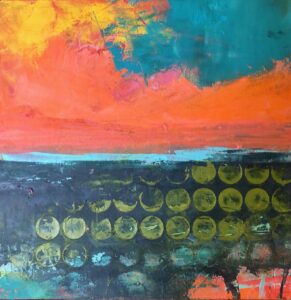
I don’t ever crave extraordinary moments anymore. Just small, gentle hums of beauty streaming from below, above, and beyond simply from paying attention. Sound. Light. Shadow. Art. Warmth. The night. The morning. Dreams that are not faraway but exist right here — already in my days, hands, and heart.
Victoria Erickson
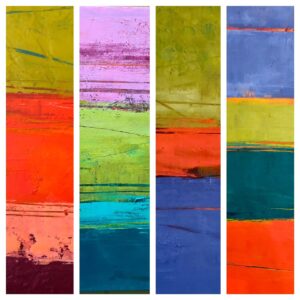
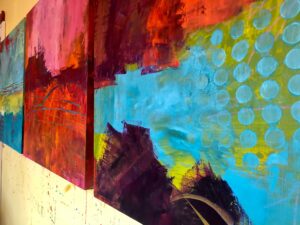
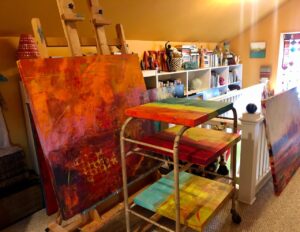
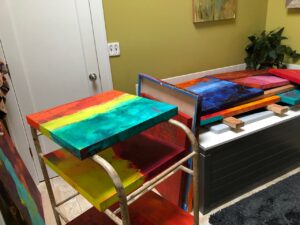
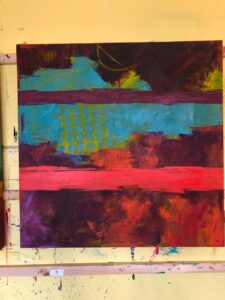
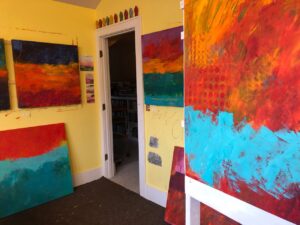
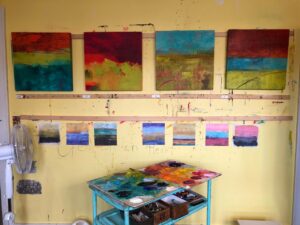
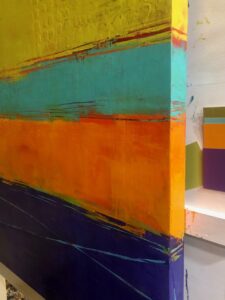
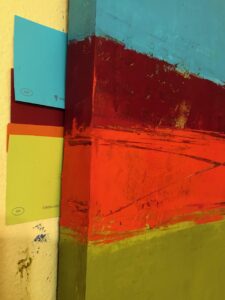
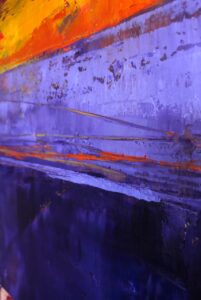
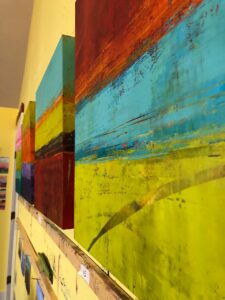
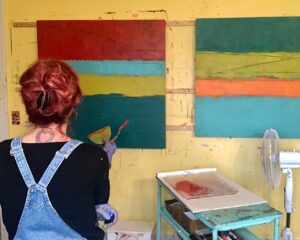
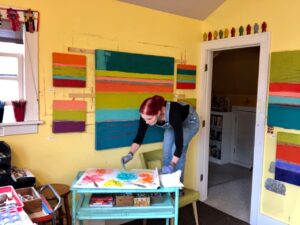
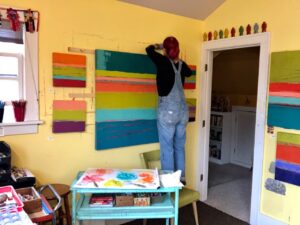
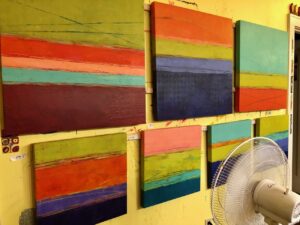
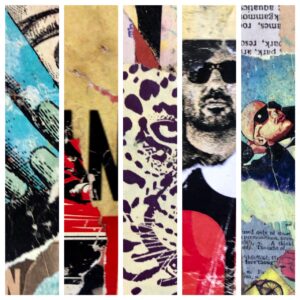
One of the projects I’ve started working on is actually a resumption of something I started a year ago, a series of long, slender, wood cradled panels (4×48 inches). All five boards had been painted black with some bands of color already added, but today I pulled them out of the basement, hung them on my rolling wall, and while painting a large canvas on the opposite wall (another long abandoned project resurrected last week), I used the leftover paint from that painting on the tall, slender panels. Layer by layer, band by band. I know that the swaths of color I used to create my Emotional Alignments series influenced this current project. Bands and swaths again, but a bit wonkier and whimsical. At least for today. I’ll be working on these right on into the new year.
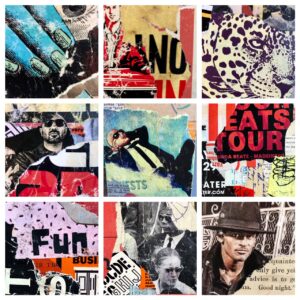
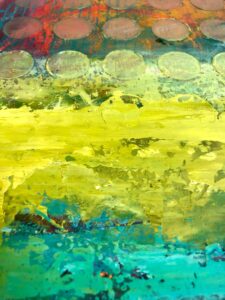
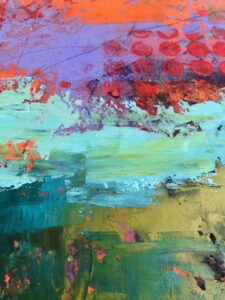
Some close-up peeks from different sections of the five panels:
So many tasks to attend to once the art has been made. First up, is removing the tape from the backs of the cradled wood panels, sanding the backs of the boards to clean up painty messes (I got a little hand sander for an early Christmas gift!), titling and signing the pieces, getting them all wired, and then photographed and inventoried. Whew.
And in between all these tasks, I needed to write my Artist Statement, something I have been laboring over for the past few weeks.
In the midst of this frenzy of activity, I realized that all 20 boards wouldn’t fit in either of our small, economical cars, so on Saturday we loaded up Howard’s car with 16 of the boards (amazing we crammed in 16), and headed to Astoria, where I planned to apply the final coat of cold wax to seal the paintings.
We got the paintings unloaded and I took over the funky upstairs space at our Astoria Beach House. I covered the table and floors and got set up to give my right arm a workout: slathering on a thin layer of cold wax with a putty knife, setting up extra heaters to warm up the upstairs, and then letting the wax dry and set on the pieces in preparation for a final buff and polish the next day.
The paintings are now buffed and polished, nestled downstairs in the extra bedroom, and I even managed to finish my Artist’s Statement this morning while it stormed and rained outside.
The details for my upcoming show:
Emotional Alignments: an emotional response to 2020
RiverSea Gallery in Astoria, located on the northern Oregon coast
January 9-February 9, 2021
Opening Reception: Astoria Art Walk, Saturday January 9, from 12-8:00 pm (to allow social distancing all day); I’ll be there from 5:00-8:00 pm.
If you read my last post, I shared about my upcoming show at RiverSea Gallery in Astoria and how my initial idea was the theme of waterlines, but somewhere along the way I realized it was no longer a theme I wanted to explore. Instead, I started thinking in bands and swaths of color, a design element I have been smitten with for years. My thoughts went to how I have always been attracted to color field art, so as I painted and worked on my boards, the idea of working in fields of color filled my consciousness. The words Emotional Alignments became the title of my show, and propelled me forward. I knew where I was going and I was excited to get into my studio every day; I had an enthusiasm I hadn’t had in a long time.
After getting all of my boards prepped, I kicked into full time painting, spending several hours a day in my studio adding layers of oil and cold wax. In my last post, I shared the process of how I prepare my boards with acrylic paint, plaster, and more acrylic paint, and now I’m showing and sharing the process of adding layers of oil paint mixed with cold wax.
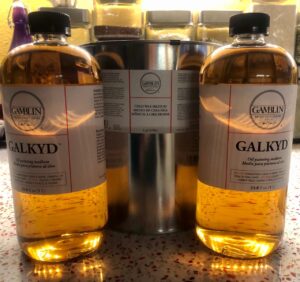
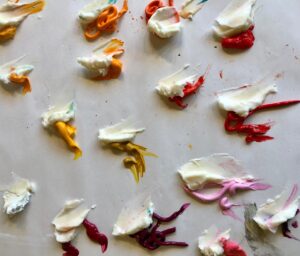
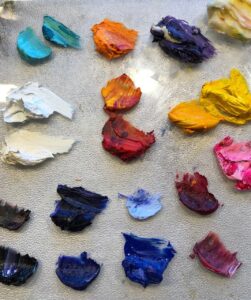
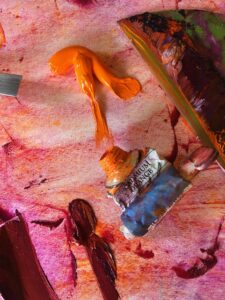
The first order of business is to mix up cold wax with Galkyd (which helps speed the drying time), then mix oil paints with the wax mixture, making it the consistency of whipped butter (or shortening if you are old enough to remember that cooking staple).
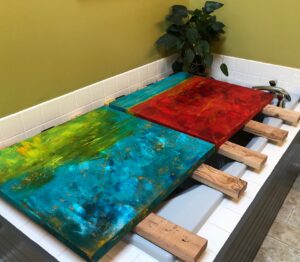
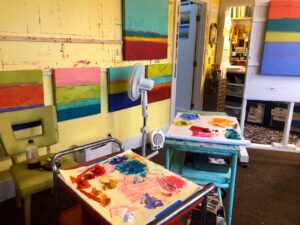
I use the early layers to just get color down so I have something to respond to. I’ve been working on 20 pieces simultaneously, so drying space is at a premium, necessitating spreading out into our bathroom and the upstairs hallway.
Once I have one or two initial layers of oil and cold wax, often alternating between warm and cool colors so when I’m scratching through the wet paint, the earlier layer is revealed, it is time to begin thinking about a composition. I knew I would be focusing on bands of color, so I just started painting swaths, giving some thought to color, but not too much advance planning at this stage.
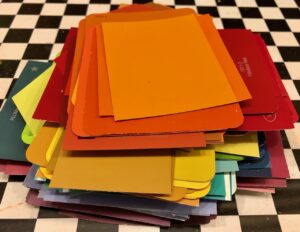
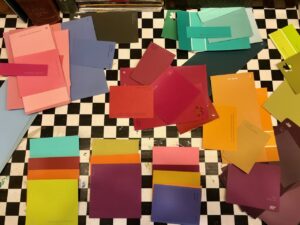
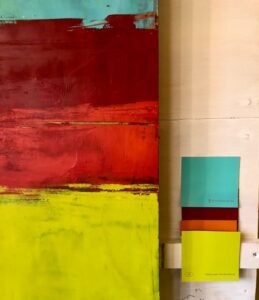
Eventually, I had another layer on the boards and it was time to begin making more informed choices to add variety within the swaths: warm against cool, texture against smooth, bright against dull, light against dark, busy against calm. I had the idea of using paint chips (from the hardware store) to play with color combinations.
I also gave a great deal of attention to the intersections between the bands of color, the interstices. I have long been fascinated with intersections: drawing into the layers to reveal earlier layers, what colors show through, adding lines of color with the edge of a squeegee, how to create bold interest, how to create quiet interest that invites a viewer to step closer to see the details.
And so it goes. Back and forth, adding, subtracting, standing back, scraping, excavating, laying down more paint. Mental and physical gymnastics.
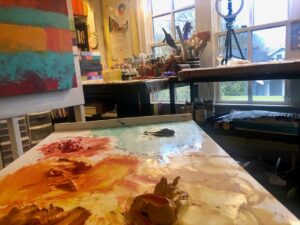
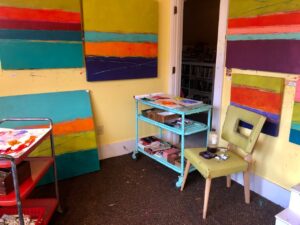
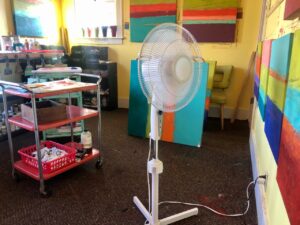
Between painting sessions, is the inbetween, the drying time. I set up a fan and a heater to blow warm, dry air around my studio, a time for the paintings to rest, a time for me to rest. It all seems to help.
Paintings are being completed and I’m excited about them. They reflect how I have moved through the pandemic, politics, wildfires, and personal traumas this past year. Titling the pieces has been as therapeutic as painting them. I think I might just be okay.
In my next post, I’ll share the completed pieces. The show, Emotional Alignments, opens Saturday, January 9, 2021, at RiverSea Gallery as part of the Astoria monthly Art Walk.
For the past couple of months I have put my nose to the grindstone. Being in the middle of a pandemic, life outside my house has been meager, so in many ways this has been the ideal time to put myself into a self-imposed studio timeout. I had the opportunity for a show at RiverSea Gallery, a contemporary art gallery in Astoria on the Oregon Coast. I have had art there for several years, I’ve been in group shows, and two years ago I had a show with my friend Stephanie Brockway. I had been thinking about asking for a solo show, but had never approached the gallery owner, Jeannine. Until October. I met with Jeannine and because of the pandemic, she was juggling the rescheduling of shows from 2020 into 2021; then she said that an artist had just cancelled for January 2021 and I could have that slot. In the big gallery. Gulp. Yes, please. Let the madness begin.
I work in layers. Many layers. It goes something like this. Gathering boards and painting them with a layer of acrylic or house paint. Once dry, I slather on a layer of plaster, which needs to dry overnight. The plastered boards are then schlepped outside to be lightly sanded, brought back into the studio, and sealed with a layer of acrylic stain. I like to baptize my boards with words, so I usually scribble a quote or something about how I’m feeling. Then I’m ready to begin actually painting. Because words don’t quite capture the physicality of this process, here is my photo essay depicting the first round of layers.
Now the boards are ready for painting.
When I originally pitched my show to Jeannine, my idea was for a show about waterlines, something I have been passionate about exploring for years. But as I began applying the initial layers of oil and cold wax, I realized the show was no longer about waterlines. When I needed to send an image to Jeannine for her November newsletter, I sent her this message:
I have been consistently working since we met in October, moving forward with the theme of Waterlines. I prepped 15 boards (20×20 inches up to 40×40 inches) with acrylic, plaster, acrylic, and then one to two layers of oil paint mixed with cold wax. As I began the process of reconciling the under layers with a finished composition, it became apparent that my heart wasn’t in a strict interpretation of waterlines. My original vision for the show was bold swaths of color representing waterlines, but as I began applying paint in bright bands of color, I realized what I was experiencing was more than waterlines; it was an emotional response to 2020: the pandemic, politics, and wildfires (as well as a series of personal family hardships). Waterlines always find their way into my pieces as inspiration, but this show isn’t about waterlines, but my emotional response to 2020. So things have changed a bit. I have titled the show: EMOTIONAL ALIGNMENTS. Once I started making this shift last week, my painting took off. I start my days enthusiastic and excited to get into the studio.
In my next post, I’ll share about the evolution of my paintings (now at 20 works in various stages of completion) using oil paint mixed with cold wax medium . . . . and the many hours I spend in my studio.
In my last post, New Studio? Almost . . . ., I wrote about revamping my studio and the need to clear out a long shelf of my creepy, vintage, broken, disheveled dolls (and doll heads). I wasn’t ready to get rid of them, but it didn’t make sense to put them in bins and store them in the shed. The dolls are my thing, not Howard’s, so I decided to live with them a while longer and the best place to do that was in my office. I began the arduous task of going through all of the dolls that I had removed from the shelves (okay, maybe I played with them for a little bit).
I found some low profile shelves and ordered two sets. Howard got them installed pretty quickly, and I began deciding which dolls would make the cut. My favorite dolls are the ones with movable eyes and little teeth, and I had collected plenty of those over the years.
If you are creeped out by cracked, crazy-eyed, and overly loved dolls, you might not want to continue, but if you are intrigued by such a motley cast of characters, here are some of my favorites.
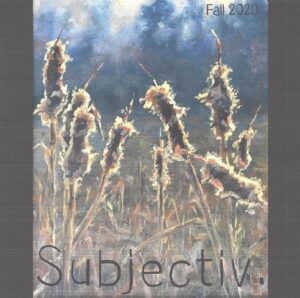
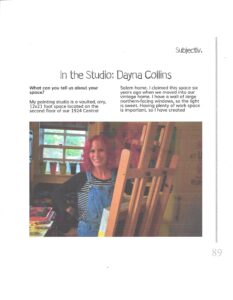
I am delighted to share the Fall 2020 issue of Subjectiv: A Journal of Visual and Literary Arts. This is a stunning online journal, filled to the brim with art and words. Riis Griffen is the editor and C.W. Griffen is responsible for the layout. I was contacted by Riis the end of August, asking if I would be the featured artist for their In the Studio article. Hello, yes, please.
Interview questions were sent, answers written out, photos were taken, photos were edited. And now here it is, in living color, a beautiful reminder of how art and words heal, help us process, bring joy, teach us to solve problems, and as Riis says in the opening of this issue, I hope you can find a few moments of peace browsing through these pages, and enjoy a break from the tumult of the world.
There are two ways to view Subjectiv. You can go to the website by clicking HERE (you can also see past issues by using this link). Or if you prefer to view it in a magazine format, click HERE.
A teaser . . . you can read my interview and see photos on pages 89-96.
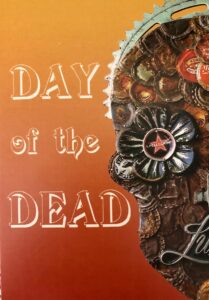
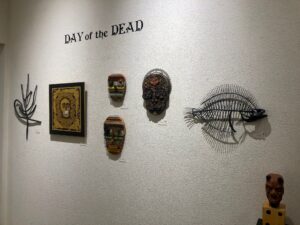
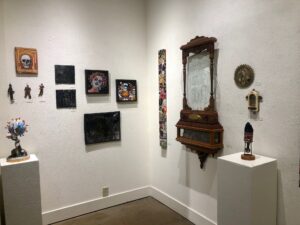
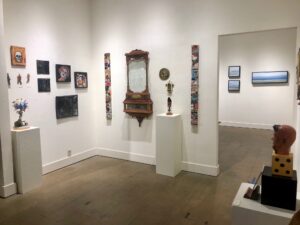
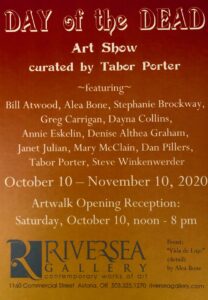
I have two pieces in the current Day of the Dead show at RiverSea Gallery in Astoria (on the Oregon Coast) and I want to share a bit about how the pieces were created. But first, the show. Tabor Porter is the curator and he invited his friends to participate. It is a small and intimate show in the Alcove of the gallery. Here is how Tabor describes the show:
The Day of the Dead reminds us to live our lives to the fullest; because death is always an integral, ever-present part of life. The present day Pandemic poignantly reminds us of that. So as we commemorate the death of our loved ones in celebration, we remind ourselves and others how important their lives were. In doing so we remind ourselves how important ours can be. This group of artists that I consider my friends endeavor to show us their relationship with this day of mourning and celebration.
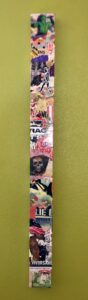
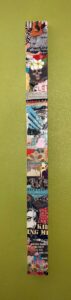
The two pieces I created for the show are 4 inches wide and 48 inches tall, making them difficult to photograph. But here goes:
If you are interested in seeing the Day of the Dead show at RiverSea Gallery, the show will be up through November 10, 2020.
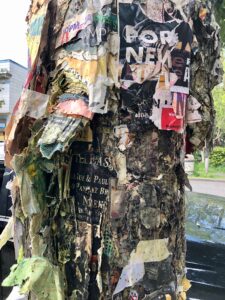
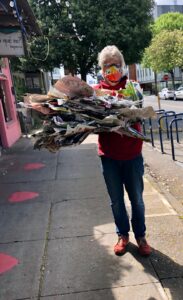
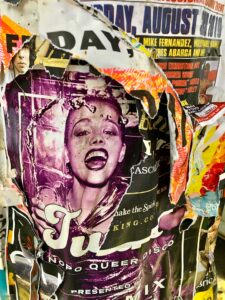
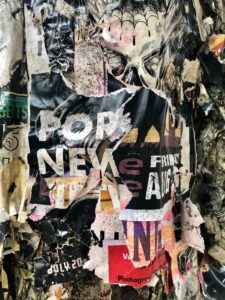
Now for the back story. I’ve been collecting random papers and ephemera for years and in more recent years, I have become an urban scavenger, pulling posters and fliers from telephone phones and buildings. As I was thinking ahead to Day of the Dead, I knew I wanted to incorporate some graffiti posters into my pieces, so as the pandemic put the state in lock down, Howard and I masked up and ventured to Portland in search of old, weathered, beat up, out-of-date fliers. The streets were empty and we were able to scavenge lots of fodder.
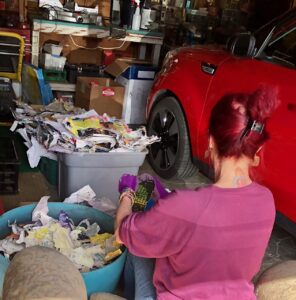
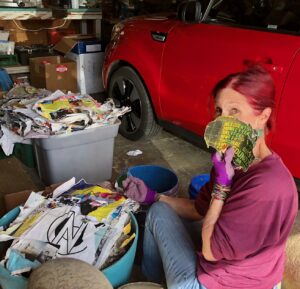
Let me tell you this about being an urban scavenger: you need gloves, tools to pull the bunched up posters from the telephone pole, and even if there isn’t a pandemic, you might want to wear a mask. The material is sometimes wet (don’t pull the posters from the bottom of the pole because sometimes it is a bit yellow, if you know what I mean), stinky with creosote, and buggy. So when we got all of the papers home, I aired them out in the garage and outside for several weeks.
Then once the paper was dryish and aired out, I had to handle every single piece to pull out all of the staples and nails. Again, gloves are a must.
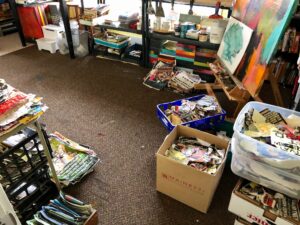
Once the processing was complete, I sorted and loosely organized the materials into bins and boxes.
I used the pieces and scraps to create my two pieces for the DOTD show at RiverSea Gallery.
“Revisiting the Past” Dayna J. Collins“Thoughts Reaching Into the Past” Dayna J. Collins
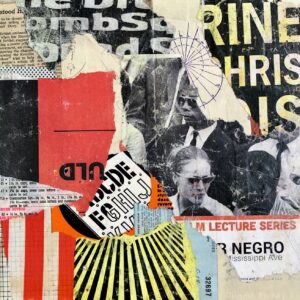
I have also used the scavenged posters and fliers in other ways; both for under layers in mixed media pieces as well as on book boards for my Salvage Collages.
Under layer for mixed media pieceBook board Salvage CollageBook board Salvage Collage
Back in April, I submitted an application to participate in the annual Word & Image: Writers and Artists in Dialogue show at the Hoffman Center for the Arts, a lively art center located on the north Oregon coast in Manzanita. My application was accepted and 12 artists and 12 writers were randomly paired during a Zoom meeting in mid June. Names were drawn from a hat and I was paired with Evan Williams. We both have North Coast connections: Evan has had a family cabin at Neahkahnie for years and lives in Portland. I grew up visiting our family cabin at Sunset Beach and now have a a house in Astoria and split my time between Astoria and Salem. Here is a bit more about Evan: Evan Morgan Williams has published two books of short stories. A Neahkahnie regular since 1969, his stories are realistic fictions, often set along the Oregon Coast. He lives in Portland, where he teaches in a high-poverty middle school.
The project worked like this (stay with me, it can sound confusing): I submitted three images of art I had created in the past. Evan submitted three pieces of his writing. Evan received an email with images of my three paintings and I received an email with copies of his three writings. I was to create a new piece of work in response to one of his writings, and Evan was to write a new story or poem in response to one of my three pieces of art.
I chose Kimberly’s Hands, which Evan said I could share in this post:
After the love-making failed, Michael let Kimberly’s hands take his. Her pleading touch was dry as paper. It didn’t used to be this way. Michael remembered his hands in water, plunged into a mountain creek ahead of an advancing burn. He and his crew had been dropped in a mile ahead of the flames. It was hazard pay, and they earned it. The creek was going to be the line. Michael did not know where that water came from or where it was going. His hands in the water, cold, clear, smooth, lifting what he could to his sooty face. There were ferns and thimbleberry along the shore, and his hands ached, and the water was clear and silent as it slid over jewel-colored stones. That little stream had no idea what was coming over the ridge. The crew tapped a portable pump into that stream, a two-stroker, ugly noise, shaking like a jackhammer, and they hosed down the brush and trees, up and down the creek, until they ran out of petrol, but it wasn’t enough. The fire came. They ditched the pump and ran for their lives. Nothing they could do. Never found that sweet water again. It was probably dry now.
“Michael, come back. It’s all right. Look at me.”
“I know it’s all right.”
Once Kimberly’s hands had felt exactly how that water used to be. Now her hands felt how that water was now.
I chose to paint my response to the story written by Evan and I began by writing his story across the surface of my prepared panel.
The story was layered and nuanced, so I added layers of oil paint mixed with cold wax. For a while the painting looked like this.
It continued to morph and I frequently reread Kimberly’s Hands.
It finally reached that point where I knew it was completed.
“Under Perilous Conditions,” plaster, oil, and cold wax by Dayna J. Collins
My process statement in response to Kimberly’s Hands:
Water, cold, clear, smooth. Ahead of the flames. The water was clear and silent. The fire came. Her pleading touch. The visual language of “Kimberly’s Hands” resonated as I translated Evan’s words into a painting. My own response conjured the passage of time, memories, the devastation of fire, the rejuvenation of water, aging, and desire. I started my piece by writing Evan’s prose across the surface of my board, then began adding layers of paint, partially covering the words. Through the use of layers, texture, and color, I created a visceral and abstracted response.
During my painting and processing over the six weeks, Evan had chosen one of my paintings, The Strange Velvet Beautiful Sea, and in response wrote Diving In.
The engine ticks down. Just enough starlight she can see her reflection in the rear view mirror. She does her lipstick.
She looks out. A tent on the dark beach waits for her. A campfire, too, but a strong shape blocks the light.
She checks her lipstick again.
They met on the beach that afternoon. He taught her how to bodysurf. The water was frigid, but he said, “Keep moving,” and this made it all right. He taught her to lunge when the wave was good, to tuck her head and dive when the wave was bad. The shock of cold, dark, quiet, was exhilarating. She emerged into the light anew.
He said, “Diving into dark water, you accept the unknown. You meet it with your face. Knowing this changes nothing. Darkness reveals its secrets just the same.” She was surprised when he added, “You learn its cold indifference.”
She said she would come back in the evening. Freshen up at the motel. She told him, “I could be into you.”
The rear view mirror says perfect. She puts the lipstick in her purse along with the pepper spray and the Lady Smith. Five bullets. All her things are small. They take up all the space in her small world.
But a mirror’s reflection is an opposite. If you see confidence in the mirror, it means you are a coward and a fool. She re-checks her reflection, isn’t sure. She dives into that unknown.
“The Strange Velvet Beautiful Sea,” oil and cold wax by Dayna J. Collins
An image of my new art and the new piece of writing by Evan were due the end of July, and art work was then dropped off the end of September. Using the imagery and writings, a book was published showcasing all of the art and writing from the 12 artists and 12 writers. (It is a beautiful book and is available at the Hoffman Center for the Arts.)
Two broadsides were created, the first featured the art I created in response to Kimberly’s Hands, and the second broadside featured the story written by Evan in response to the art that I had submitted.
Fast forward to October when everything was revealed at the opening reception, which took place virtually because of you know what.
The reception was on a Friday night, and the exhibition opened on Saturday, October 3; we were able to visit the show on the following day. What a thrill to see the exhibit in person. The woman who was gallery sitting that afternoon said several people had expressed an interest in purchasing Under Perilous Conditions and someone had purchased my piece that afternoon.
. . . . or what I did during The Great Pause Pandemic of 2020.
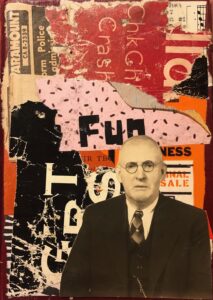
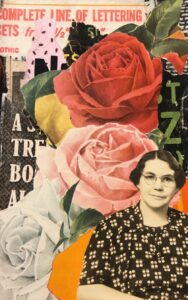
“The Poetry of Silence,” Salvage Collage by Dayna Collins” With a Theatrical Flourish,” Salvage Collage by Dayna Collins“Time of Roses,” Salvage Collage by Dayna Collins“Wistful Amazement,” Salvage Collage by Dayna Collins“The Bits and Bones of a Life,” Salvage Collage by Dayna Collins“Paris in a Week,” Salvage Collage by Dayna Collins“Rebellious Tendencies 1,” Salvage Collage by Dayna Collins“Strands of Thought,” Salvage Collage by Dayna Collins“Poetic Effect,” Salvage Collage by Dayna Collins“Exquisite Fragments,” Salvage Collage by Dayna Collins“Are You Going Skating After School,” Salvage Collage by Dayna Collins“A Delightful Surprise,” Salvage Collage by Dayna Collins“A Matter of Celestial Balance,” Salvage Collage by Dayna Collins“A Reckless Act,” Salvage Collage by Dayna Collins“A Distant Calamity,” Salvage Collage by Dayna Collins“Dream of Escape,” Salvage Collage by Dayna Collins“Easy to Read,” Salvage Collage by Dayna Collins“Without a Doubt,” Salvage Collage by Dayna Collins“A New State of Wonder,” Salvage Collage by Dayna Collins“A Secret Obsession,” Salvage Collage by Dayna Collins“Rebellious Tendencies 2,” Salvage Collage by Dayna Collins
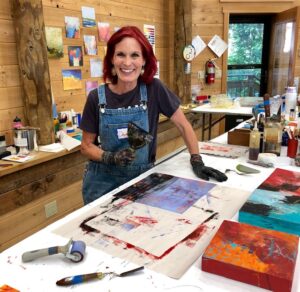
Frenzy might be an overstatement, but I have been spending more time in my studio and after a fairly long hiatus, I have returned to painting with oil and cold wax.
Since 2016, I have taught a four-day Abstracted Landscape class at Sitka for Art and Ecology on the Oregon Coast. Because of the pandemic, this year’s class, which was sold out and scheduled for August 21-24, was canceled (as were all classes at Sitka).
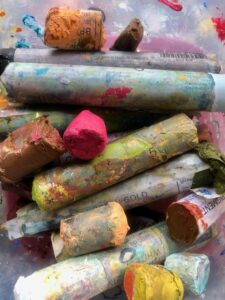
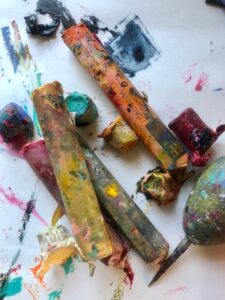
Somehow the idea of not teaching this year inspired me to jump back in to oil and cold wax after several months of painting with acrylics and working on a series of collages. It felt good to crack open the gallon of cold wax and whip up a satisfying mound of wax, begin choosing tubes of oil paint to mix, and dig out my R & F Pigment Sticks.
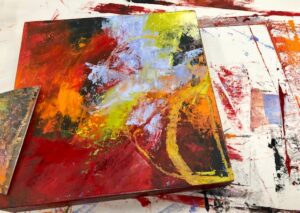
I had one deadline for a painting (so that was a BIG motivator to get into the studio and do some painting and I’ll share about that project when I can), but otherwise, I decided to pull out old boards that I had used for demos in my Sitka class last year. None of the pieces were completed, they just had fits and starts of paint and marks on them, all used to illustrate techniques and then set aside. It was nice to have something to respond to besides a plain, blank, board.
Technique demo board
I also revamped a few boards that had been completed paintings, but something was niggling at me and those pieces got a light sanding to rough up the surface, and then I started over. It was nice to erase an old painting, but know that there was that sense of history lurking below the surface.
the presence or emergence of earlier images, forms, or strokes that have been changed and painted over.
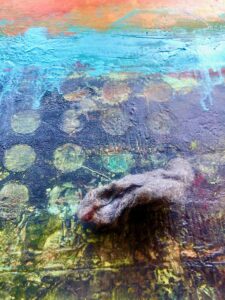
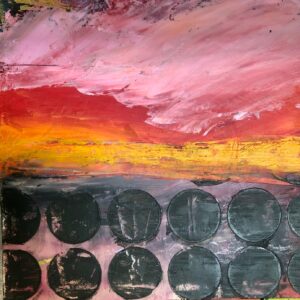
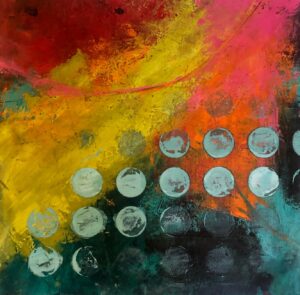
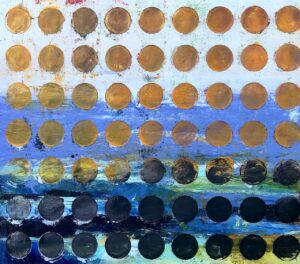
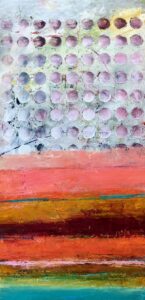
What has emerged during my extended painting sessions is the reoccurring theme of circles. I have always loved polka dots and circles and they have shown up in my work for years, but lately I have tipped over into obsession.
obsession
[/əbˈseSHən/]
noun
the domination of one’s thoughts or feelings by a persistent idea, image, desire, etc.
I’m using circles to excess and eventually I’ll reign myself in. Or not. In the meantime, here are several pieces in various stages of completion. All are on cradled wood substrates and they all have either Venetian plaster or limestone clay (the fancy name for joint compound) as an under layer. Other than that, some of the paint is from an earlier completed piece, or is from a demo at Sitka. Almost all of these have circles somewhere as a layer – in the plaster, buried in the paint, added on top of the paint, or some of the paint removed using a stencil to reveal paint, the circles serving as a window into an earlier layer.