Painting Frenzy


Frenzy might be an overstatement, but I have been spending more time in my studio and after a fairly long hiatus, I have returned to painting with oil and cold wax.
Since 2016, I have taught a four-day Abstracted Landscape class at Sitka for Art and Ecology on the Oregon Coast. Because of the pandemic, this year’s class, which was sold out and scheduled for August 21-24, was canceled (as were all classes at Sitka).
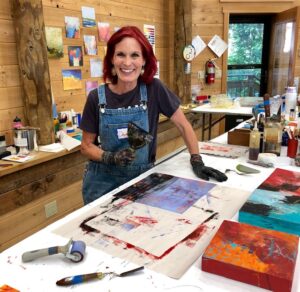
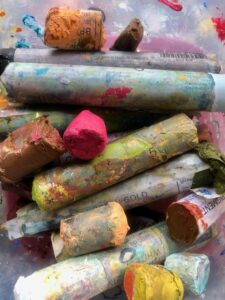
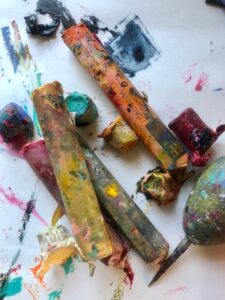
Somehow the idea of not teaching this year inspired me to jump back in to oil and cold wax after several months of painting with acrylics and working on a series of collages. It felt good to crack open the gallon of cold wax and whip up a satisfying mound of wax, begin choosing tubes of oil paint to mix, and dig out my R & F Pigment Sticks.
I had one deadline for a painting (so that was a BIG motivator to get into the studio and do some painting and I’ll share about that project when I can), but otherwise, I decided to pull out old boards that I had used for demos in my Sitka class last year. None of the pieces were completed, they just had fits and starts of paint and marks on them, all used to illustrate techniques and then set aside. It was nice to have something to respond to besides a plain, blank, board.
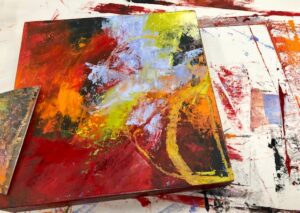
Technique demo board

I also revamped a few boards that had been completed paintings, but something was niggling at me and those pieces got a light sanding to rough up the surface, and then I started over. It was nice to erase an old painting, but know that there was that sense of history lurking below the surface.
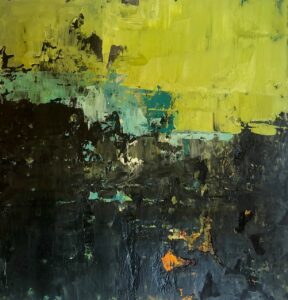
pen·ti·men·to

[ pen-tuh-men-toh ]

noun, plural pen·ti·men·ti  [pen-tuh-men-tee] . Painting.

the presence or emergence of earlier images, forms, or strokes that have been changed and painted over.


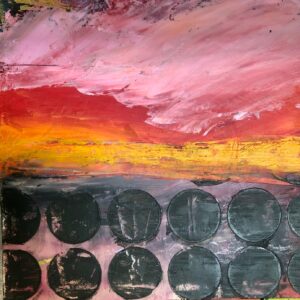
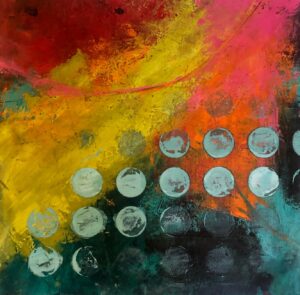
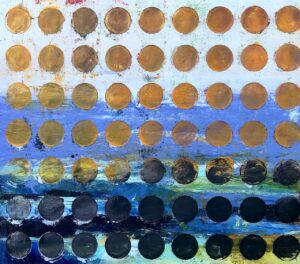
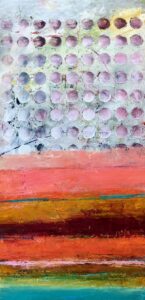
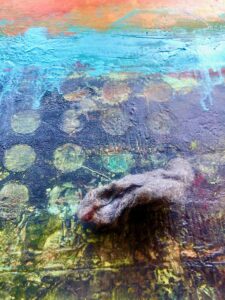
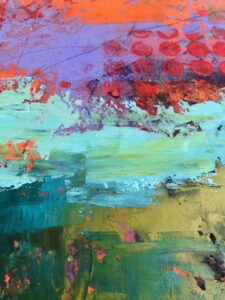
What has emerged during my extended painting sessions is the reoccurring theme of circles. I have always loved polka dots and circles and they have shown up in my work for years, but lately I have tipped over into obsession.
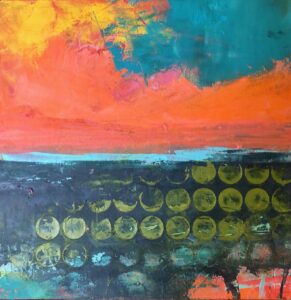
obsession

[/əbˈseSHən/]

noun

the domination of one’s thoughts or feelings by a persistent idea, image, desire, etc.


I’m using circles to excess and eventually I’ll reign myself in. Or not. In the meantime, here are several pieces in various stages of completion. All are on cradled wood substrates and they all have either Venetian plaster or limestone clay (the fancy name for joint compound) as an under layer. Other than that, some of the paint is from an earlier completed piece, or is from a demo at Sitka. Almost all of these have circles somewhere as a layer – in the plaster, buried in the paint, added on top of the paint, or some of the paint removed using a stencil to reveal paint, the circles serving as a window into an earlier layer.
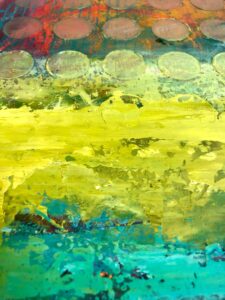


Obsessive Quarantining Activity

Before all hell broke loose, I registered for Nicolas Wilton’s popular 12-week ART2LIFE Creative Visionary Program. If you aren’t familiar with it, here’s how Nicolas explains it:

The program is designed for beginner to advanced artists who are interested in significantly shifting and improving their art. This program will guide you into a better understanding of your own unique creative expression. Over the 12 weeks, we will be taking a deep dive into all the 6 Art2Life Principles – Design, Value, Color, Texture, Risk and Soul.

Gaining a thorough understanding of the nuances and interconnectedness of these fundamental principles will allow you to have tremendous creative freedom in any kind of art-making you desire to pursue. Whether you paint realistically or abstractly, draw, paint, collage or any combination of the three, this intensive program will give you all the tools you need. The program is principle-based and its primary purpose is to clarify and strengthen your own authentic creative expression.

The program and the Art2life team of coaches provides you with an amazing community of supportive artists, concise ways to create a more sustainable,  joyful art practice and most importantly, the fundamental art-making principles to finally bring your Art to life.

The program is intensive and to do it even nominally, requires several hours a week, and that is without doing any painting. Then, all hell broke loose when Covid-19 began gaining ground and I found myself with extra time to jump all in to the ART2LIFE Creative Visionary Program. However, this post isn’t about the program, but about how Nicholas has all of his paints in squeeze bottles, often the type that restaurants use for ketchup and mustard. One of the benefits of using the squeeze bottles is the consistency of the paint, not too thin (fluid paints don’t work for this program) and not too thick (like tube paints). Nicolas has his own line of paint that are the perfect consistency, but Nicholas is generous with information and he has shared how to get paint to the right consistency.

For the past two weeks, I have been on a mad tear sorting all of my paints, throwing out old dried up ones, and then combining like colors into a mixing bowl, whipping, stirring, adding mediums and water, and then pouring my energized and reformulated paints into plastic condiment bottles. Most of the time I mixed like colors together, even if they were from different brands, but sometimes I just mixed up an assortment of colors, like several different greens, which after mixing I dubbed “Weirdo Green.”

It has consumed me, it’s been messy, but the end result is a beautiful cacophony of colors. No more excuses not to paint.

A side benefit in the clean up process, is that I started wiping excess paint onto a large canvas and I’ve ended up with a vibrant first layer.


Featured Artist at Open Studios: Salvage Collage

I was the featured artist at our recent quarterly Open Studios at the Mill, held on February 13. My show focused on a series of revamped and new Salvage Collages as well as some acrylic paintings done on book board covers, utilizing my materials in a new way. I worked on pieces feverishly right up until it was time to get the show hung.

Artist Statement about my Salvage Collages:

Dayna Collins has always loved old books. She hyperventilates at the sight of books which are stained, defaced, torn or marked up. She rips battered books apart, reclaiming their faded fragments, and creates collages using only materials she has excavated.  Dayna’s mixed media pieces reflect the passage of time, repurposing the scraps that are worn and weathered, transforming the aged and tattered pieces into something unexpected and beautiful, celebrating their fragile decay.

My husband hung my show in two stages, and it turns out he has quite a knack for curating and hanging.

The end result was quite nice.

Some of the pieces in the show:

And some of the paintings on book boards:


Many thanks to those who stopped in to say hello, and to Luis Noriega for attending our Open Studios and interviewing some of our artists for his podcast: Down the Rabbit Hole DTRH Podcast

Head’s Up: Next opportunity to see my Salvage Collages will be at a Pop – Up in July in Astoria, Oregon! 

Daily Art Practice: Visual Painting Journal – Final Pages

I did it! During 2019 I set a goal of painting in my visual journal every day. I sometimes fell behind if I was out of town, other times I took my paints and journal along with me and kept up. I fell waaaayyy behind in mid December and it took me until mid February to get completely caught up, but family medical emergencies are never convenient.

I filled 6-1/2 visual journals (I wrote about my process and the type of journals I used here) and created 366 pages of paintings (I accidentally painted two pages for the same day). Throughout the year I did blog posts sharing about my project and posting photos of my favorite pages; now I want to share some final photos of favorite pages created since my last post in early November.

November 9, 2019
Dayna J. Collins
November 10, 2019
Dayna J. Collins
November 13, 2019
Dayna J. Collins
November 19, 2019
Dayna J. Collins
November 22, 2019
Dayna J. Collins
November 24, 2019
Dayna J. Collins
November 30, 2019
Dayna J. Collins
December 1, 2019
Dayna J. Collins
December 3, 2019
Dayna J. Collins
December 4, 2019
Dayna J. Collins
December 5, 2019
Dayna J. Collins
December 6, 2019
Dayna J. Collins
December 9, 2019
Dayna J. Collins
December 13, 2019
Dayna J. Collins
December 22, 2019
Dayna J. Collins
December 25, 2019
Dayna J. Collins
December 26, 2019
Dayna J. Collins

It was a great year. Some of my takeaways:

  • I challenged myself to get into my studio every day.
  • I experimented with new ideas.
  • I pushed myself to use different colors and compositions.
  • I explored using a bigger vocabulary of marks and lines.
  • I challenged myself to be bold and at times audacious.
  • I had fun, which helped me paint loose.

Mission accomplished.

Page dividers from the past year.

And now I’m doing something different for 2020. . . . . . .

Daily Art Practice: Visual Painting Journal – Selected Pages

I will soon complete journal #6 in my quest to do a daily painting in my visual journal throughout 2019. We’ve been revamping a house in Astoria on the Oregon coast, so I’m about a week behind  two weeks behind in my daily paintings, and I plan to get caught up after Thanksgiving. Yesterday I cataloged the pages I have completed since early October, so I thought I would share some of my favorites.

October 6, 2019
Dayna J. Collins
October 7, 2019
Dayna J. Collins
October 8, 2019
Dayna J. Collins
October 9, 2019
Dayna J. Collins
October 10, 2019
Dayna J. Collins
October 20, 2019
Dayna J. Collins
October 23, 2019
Dayna J. Collins
October 23, 2019
Dayna J. Collins
October 27, 2019
Dayna J. Collins
October 28, 2019
Dayna J. Collins
November 3, 2019
Dayna J. Collins
November 4, 2019
Dayna J. Collins

In the Zone

It has been a long time since I painted with oil and cold wax. I’ve kept up with my daily acrylic painting in my visual journal and I have been steadfast in working on my Salvage Collages, but my oil paints and cold wax medium sat quietly on the shelves, waiting for my return. Deadlines are great motivators.

Guardino Gallery is hosting their 19th annual Little Things show and work is due this month. Earlier, I completed seven small abstract paintings, but I had hoped to have at least 12 for the show. Everything in the Little Things show needs to be 7×7 inches or smaller, so my pieces are all 5×5 inches, a fun size to paint and a size that keeps the price affordable.

Sunday turned out to be a quiet day and I had the house to myself, so I headed to my painting studio, quickly painted in my daily visual journal, then pulled out my gallon of cold wax and began choosing oil paint colors I wanted to work with. I lined up nine 5×5 boards; six of them had the beginnings of paintings and three I had deemed completed. All nine got a makeover. It felt great to work primarily in a limited palette of warm colors: pinks, magentas, reds, oranges . . . . with dabs, lines, and swaths of other colors to add contrast and variety.

“The Strange Dance of Movement Over Time,” oil and cold wax by Dayna J. Collins
“A Cloud of Tenderness,” oil and cold wax by Dayna J. Collins
“Secret Yearnings,” oil and cold wax by Dayna J. Collins
“The Memory of That Night,” oil and cold wax by Dayna J. Collins
“A Field of Feverish Energy,” oil and cold wax by Dayna J. Collins
“A Hot and Windless Summer Day,” oil and cold wax by Dayna J. Collins
“Words Have No Sound,” oil and cold wax by Dayna J. Collins
“Too Many Surprises,” oil and cold wax by Dayna J. Collins
“Hushed By the Wind,” oil and cold wax by Dayna J. Collins

These were three of the initial seven that made the cut:

“Whispered Words,” oil and cold wax by Dayna J. Collins
“State of Disorientation,” oil and cold wax by Dayna J. Collins
“The Pink Light of Dawn,” oil and cold wax by Dayna J. Collins


Little Things 19 opens Friday, November 29, 6-9 pm, at Guardino Gallery in Portland on NE 30th and Alberta.


Daily Art Practice: Visual Painting Journal – Recent Pages

August 27, 2019
Dayna J. Collins

Time for an update of my year long project of painting in a visual journal every day. Here’s a selection of pages from late summer through early fall. Favorites:

August 11, 2019
Dayna J. Collins
August 12, 2019
Dayna J. Collins
August 31, 2019
Dayna J. Collins
September 1, 2019
Dayna J. Collins
September 4, 2019
Dayna J. Collins
September 5, 2019
Dayna J. Collins
September 14, 2019
Dayna J. Collins
September 16, 2019
Dayna J. Collins
September 18, 2019
Dayna J. Collins
September 19, 2019
Dayna J. Collins
September 21, 2019
Dayna J. Collins
September 22, 2019
Dayna J. Collins
September 25, 2019
Dayna J. Collins
September 27, 2019
Dayna J. Collins
September 28, 2019
Dayna J. Collins
September 29, 2019
Dayna J. Collins
September 30, 2019
Dayna J. Collins
October 2, 2019
Dayna J. Collins
October 5, 2019
Dayna J. Collins

Themes continue to emerge: Play, experimentation, circles, layers, mark-making, revealing, excavation, color, lines . . . . and I’m in the final three months of my project.

Salem Poetry Festival

I was invited by the Salem Poetry Festival to paint while two poets read a series of their poems during the Salem Poetry Festival. Last Thursday, I arrived early at the Ike Box in downtown Salem to set up my table. I chose to bring four 11 x 14 canvases and two table easels, with the plan to paint two pieces as each poet read their poetry for about 30 minutes each.

The idea was that my painting would be in response to the poems being read. To prepare for the evening of painting, I repurposed four canvases I had bought at SCRAP, painting over someone’s previous painting to prepare it for my use; I painted two of the canvases black and two in hot pink and orange, giving me something to respond to other than a blank, white canvas.


Poet Carol Hottle kicked off the event and my first painting was in response to her reading a series of poems about a transformational experience she had, surviving a horrific auto accident.

My second painting was in response to a series of poems that reflected positive experiences, and I allowed myself to focus on the visual images Carol painted with her words.

When it was time for poet Mike Shuler to read, I listened as he read until I picked up on a poem about children joyfully playing along the banks of a river, and I couldn’t resist painting a bright abstracted landscape.

The second piece I painted was in response to Mike sharing how much he loves hiking in the Cascade Head area, a place that is near and dear to me because it is where Sitka Center For Art and Ecology is located (and where I taught two painting classes this summer).

The whole experience was positive and fun and once I started painting, I tuned out the room full of people and just focused on the flow of words and the flow of paint.  At the conclusion of the evening, I invited both poets to choose a painting to take with them.

Salem Poetry Festival
Thursday, September 12, 2019
Carol, Dayna, and Mike


Abstracted Play in Oil and Cold Wax: August 2019

What a wild week. Twelve women artists came together to take my Abstracted Play in Oil and Cold Wax workshop at the Sitka Center for Art and Ecology. Some had taken my class previously, a few had learned from other instructors, and quite a few had never worked with oil paint or cold wax, and one was new to painting. There was some gnashing of teeth, lots of laughter, a little whining, a smidgeon of frustration, and in the end, happiness with their success and the beauty of their pieces.

I did demos every morning and afternoon . . .

The women then worked on their own pieces, working in multiples so they had lots of pieces to work on at various stages of the process.

One thing I loved seeing was the camaraderie of how the women supported each other and worked together.

I gave my Artist Talk on Saturday after lunch (they all showed up for my talk, although this photo makes it look like no one did!).

On our last day, we worked in the morning and then in the afternoon cleaned up our supplies, spread out our body of work, and did a walkabout, sharing the highlights of the week.

Here is an assortment of the work created during the week, in no particular order, some on boards, some on Arches Oil Paper, some large and some small:

It was a really fun week.

PS This was the second time I got to teach at Sitka this summer. In June, there was an opening and I was able to slip in a bonus version of this workshop, which I blogged about earlier.

Daily Painting Journal: How I Do It

Several people have asked me if I plan to offer a class on how I keep a daily painting journal. Whenever I’ve been asked, I’ve thought, I just paint something every day in a book. But there is more to it than that, so rather than a class, I thought I would share using my blog as the means to convey the details of what I do and the benefits of why I do it.

I’ll start with why I decided to keep a daily painting journal. The simple answer is I wanted to have a prompt or motivation to get me into my studio. I figured if I set an intention to do a small daily painting, I might just linger and do something else and build upon the time I spend in my studio. Many times that has happened, but other times, I do my painting and that is it for the day; but it is something.

Another reason I decided to start a practice of creating a small painting in a journal is that it allows me to experiment and play with ideas. By creating in a small journal, the painting isn’t precious, it isn’t for anyone but me, and it allows me a certain amount of freedom that painting on a large canvas or painting for a show doesn’t allow me.

What I learned along the way:


  • It’s fun. Sometimes I don’t want to stop and I allow myself to put leftover paint from my current page onto the next day’s page so I have something to respond to the next day.


  • It isn’t precious when it’s in a journal. It seems my inner critic is quieted by painting on the page of a journal. I approach it as just practice or at best playtime, so the censors are muted.


  • I was inspired along the way. I often use my daily journal pages as inspiration for bigger paintings, either in acrylic or in oil and cold wax. The pages allow me to play with colors and compositions so when it is time to show up in the studio and create bigger pieces with a deadline or for some other purpose, I have lots of ideas to choose from and use as a spring board, even if the finished piece looks nothing like my journal page.

My process:

  • It is important to have a dedicated space for doing my daily paintings. I have a table set up in my studio with acrylic paints, paintbrushes, palette knives, a brayer, water, paper towels, and mark-making implements such as pencils, acrylic paint pens, and oil pastels.

  • I use a 9×9 inch Super Deluxe Mixed Media journal by Bee Paper Aquabee (manufactured in Beaverton, Oregon). The journal has 60 sheets and the pages are 93 lb. weight; the journals retail for $21.25 (and at the time of this blog post, they are on sale at Dick Blick for $10.04).

  • I cover each journal with handmade paper, using sandpaper to rough up the cover’s surface, then adhering the paper with matte medium.

  • When I started this project at the beginning of the year, I painted an entry on each side of the page, but after a few days I wondered if I might want to do something with the individual paintings, i.e., pull them out and hang them for a show, or pull them out and mount them to a panel. If I had paintings on each side, I wouldn’t be able to do either of those things, so I quickly abandoned double-sided painting and now use one page for each daily painting. I go through journals more quickly, but I have options if I choose to do something with all or some of the paintings in the future.


  • I use acrylic paint on the pages. A few times I’ve incorporated collage, but so far the focus has primarily been on creating abstract paintings. For making marks, I use No. 2 and Stabilo pencils, Woody chunky crayons, acrylic pens, and oil pastels.


  • In my first four journals, my paintings are in the middle of the page, going out toward the edges, but not to the edges. When I started my fifth journal on August 11 (Day #223), I was ready to mix it up and started painting all the way to the edge on all four sides.

  • I let the paintings dry thoroughly, but for the first few days after I have painted a page, I insert a piece of wax paper to prevent the pages from sticking together.

  • I number and date each page, and then photograph each painting, which I store on my computer by the “day” number.


  • I regularly post photos of my daily paintings on Instagram and on my Facebook art page; I share selected photos on Pinterest, and on occasion, I do a blog post highlighting some of my favorite pages. Here are links to previous posts:

January 25, 2019

March 27, 2019

May 28, 2019

August 2, 2019

I recommend giving a daily painting journal a try, using my methods or coming up with something that works for you. The benefits are more than worth the effort and I love watching my journals stack up.